When talking about electric underfloor heating, voltage plays a key role — but it’s only part of the story. To truly understand performance and safety, you also have to consider how the heating element itself is built.
1. Understanding Voltage
In most Australian and European homes, the standard voltage supply is 230 V ± 10 % (commonly referred to as 220–240 V). This is the same power level that feeds everyday appliances, lighting, and electric heating systems.
Some systems use 12 V, classified as “extra-low voltage”, which was historically chosen for safety reasons, especially where water was present or old electrical protections were limited.
2. How Voltage Affects Heating Design
From an electrical standpoint, the difference between 220 V and 12 V is fundamental.
For the same power output, a lower voltage requires much higher current.
This means a 12 V mat needs thicker conductors or shorter runs to deliver the same heat.
In practice, this limits a 12 V heating mat to only 2–3 m² at around 150 W/m², whereas 220 V systems can heat entire rooms with a single circuit.
Therefore, 12 V solutions are typically reserved for very small zones or special applications such as wellness pods, pet enclosures, or horticultural uses.
3. Safety: Then vs Now
Decades ago, when homes lacked modern RCDs (residual-current devices) and circuit breakers, 12 V was considered safer because it could not deliver a harmful electric shock.
Today, however, those protections are mandatory. In a compliant 230 V installation, RCDs detect any current leakage in milliseconds and instantly cut the power — effectively neutralising the original safety advantage of 12 V.
4. Why Warmset Redefines Safety Beyond Voltage
Voltage alone doesn’t determine safety, construction needs to be considered as well
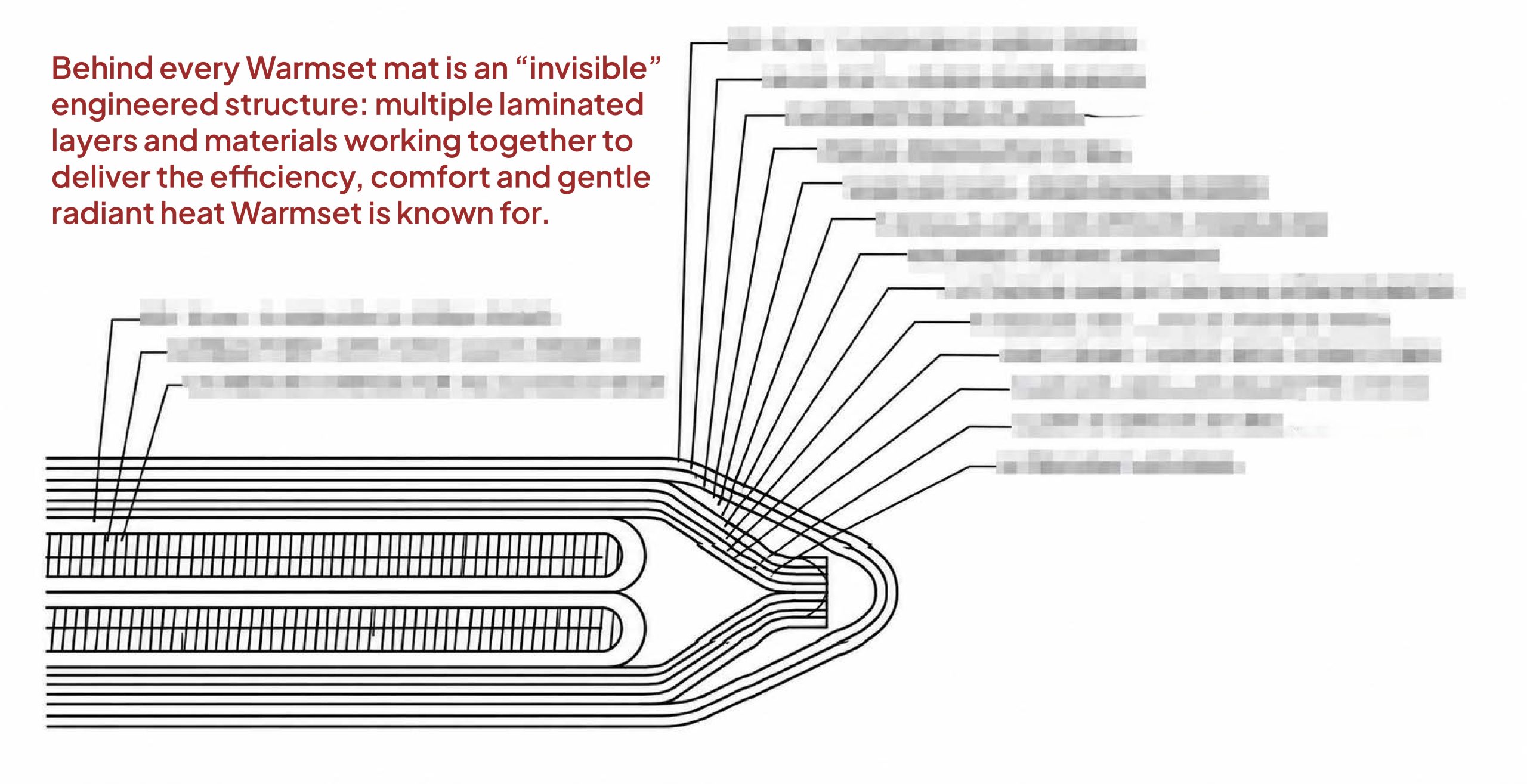
Warmset’s Italian-engineered heating ribbon includes:
- 11 layers of insulation, each with a specific function to isolate, protect, and stabilise heat output;
- A groundable outer layer connected to the building’s earthing system, eliminating step-voltage risk;
- Exceptional moisture resistance, verified for use under tiles, in screed, and even in high-humidity areas such as hammam and spas.
These features far exceed the safety standard requirements for electric underfloor heating and make Warmset systems inherently secure — whether operating at 12 V or 230 V.
5. Efficiency and Practicality
While Warmset can produce both 12 V and 230 V versions, standard-voltage systems remain the practical choice for most applications because they:
- Cover larger areas with fewer circuits and no step-down transformers;
- Maintain stable efficiency (no transformer loss);
- Integrate easily with thermostats and smart controls.
In contrast, 12 V systems require a transformer, adding cost, space, and minor conversion losses.
6. The Balanced View
Modern electrical safety relies on intelligent system design, not simply low voltage. Warmset’s advanced multi-layer ribbon, grounding architecture, and Italian quality control ensure that even at 230 V, the system achieves the highest possible safety and performance standards.
So, while both voltages are technically viable, Warmset’s patented construction virtually eliminates the historical reason for choosing 12 V, allowing you to enjoy efficiency, safety, and comfort without compromise.
We do understand that some clients may still prefer to stick to 12 V, and that is perfectly fine: you can still enjoy your Warmset far-infrared heating at 12 V, just ask us!